430 vs 304 Stainless Steel Grease Filters: Which Material Should You Choose?
430 vs 304 stainless steel grease filters compared: corrosion resistance, cost, magnetism myths, compliance points and lifecycle cost for buyers.
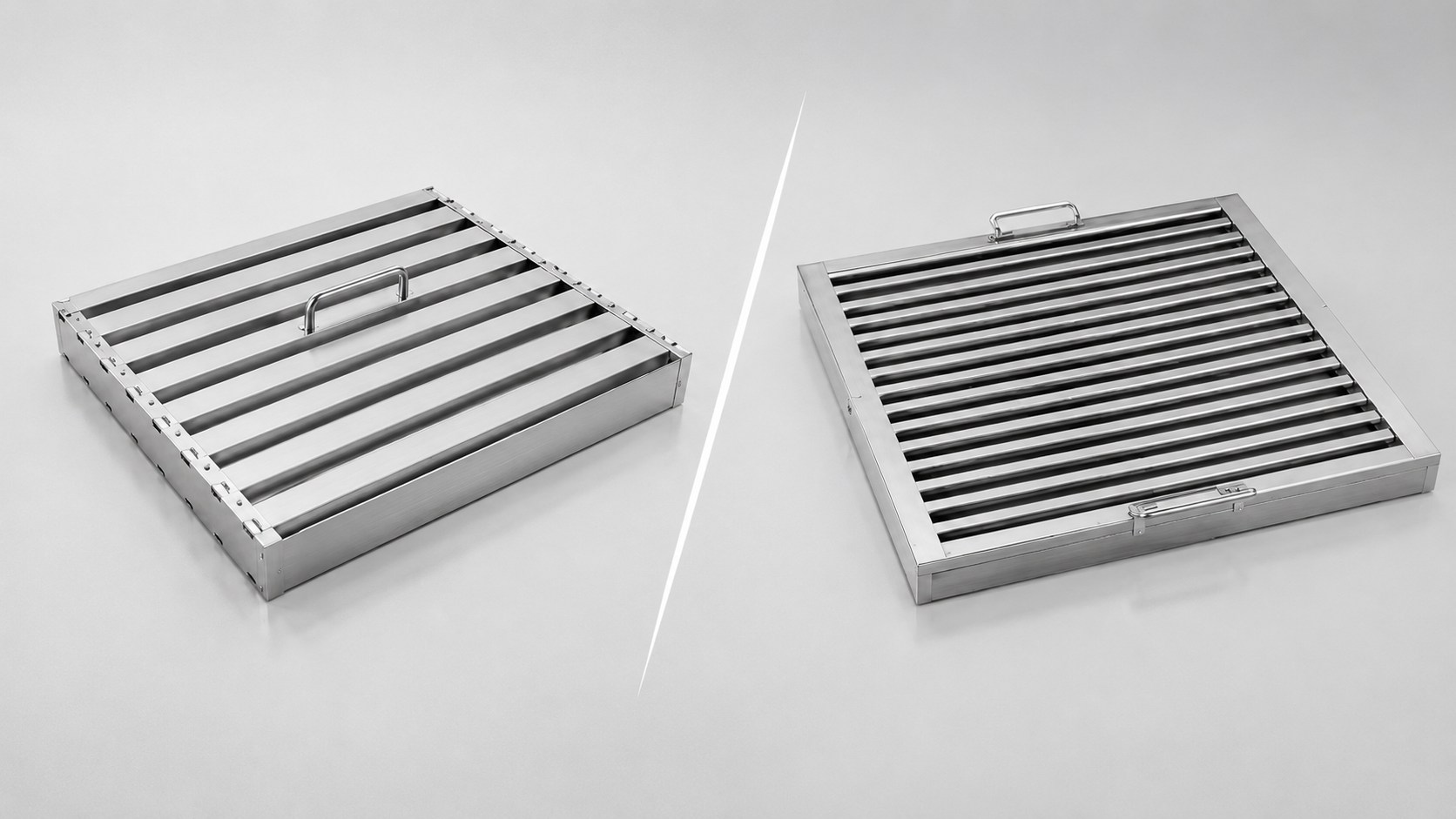
Why does stainless steel grade matter?
Choosing the right stainless steel grease filter is more than comparing material cost. A filter must fit your hood, clean easily, resist corrosion, stay rigid in use and support kitchen fire safety.
Grade 304 is an austenitic stainless steel; grade 430 is ferritic. Both are common in food processing, but their corrosion resistance is not equal — 304 generally outperforms 430.
Grease filters get washed frequently, so the material faces water, alkaline detergents, food acids, salt and heat every day. An unsuitable grade shows staining or corrosion sooner.
The magnetism myth
Many buyers use a magnet to judge stainless quality — this is generally a misnomer. 430 is magnetic because it is ferritic; 304 is generally non-magnetic, though forming and welding can give it a slight magnetic response.
A magnetic filter is not automatically poor quality; it may simply be 430. The better question is whether the grade fits the kitchen's cleaning schedule, humidity, budget and expected service life.
When to choose 430
430 is an economical grade suited to moderate kitchen environments, provided filters are cleaned regularly and not exposed to severe corrosion.
Practical advantages: lowest cost among common stainless grades (less nickel than 304) with a clean stainless appearance — a good fit for distributors serving replacement work and price-competitive projects such as mid-size kitchens with normal cooking and maintenance routines.
Limitations: corrosion resistance. In humid kitchens, coastal areas or operations using strong cleaning chemicals, 430 may stain or rust faster than 304. Also check frame rigidity, baffle design, handle strength and edge finishing rather than judging by grade alone.
When to choose 304
304 is chosen where stronger corrosion resistance, a cleaner look over time and the demands of a busy commercial kitchen matter.
It is often recommended for high-volume restaurants, hotel kitchens, central kitchens, large catering operations and very humid or coastal environments — and for filters frequently washed in dish tanks or with stronger cleaning solutions.
304 reduces replacement pressure in aggressive situations, though filters still require regular cleaning, drying and careful handling. Before paying more, also verify wall thickness, baffle angle, frame welds, handle design, water drainage path and actual fit inside the hood — a higher grade does not excuse poor construction.
Compliance and safety points
Grease filters are part of a kitchen ventilation system, not simple sheet metal to be judged on price alone. Fit, rigidity and cleaning access matter — and so do the listing requirements of your market.
UL 1046 covers single-stage and multi-stage grease filters for installation in exhaust ducts, intended for use with NFPA 96 and the International Mechanical Code. Where listed filters are required, confirm the specific product, size and construction meets the requirement.
Specifying "stainless steel" from a supplier is not the same as seeing the item on a listing, nor its fire performance, nor local code approval. Useful documents to request: material specifications, product drawings, size tolerances, packaging details and cleaning instructions. For a listing or test report, the document must match the exact product ordered.
For replacement filters, double-check width, height, thickness, handle position, airflow direction and hood system compatibility before purchasing.
Lifecycle cost thinking
The cheapest filter is not necessarily the lowest-cost option. Lifecycle cost includes purchase price, cleaning labor, replacement frequency, freight damage from poor fit and downtime from filter failure.
During sample approval, check welds, frame, baffle spacing, surface finish, drainage and sharp edges. The filter must be easy to remove, wash, dry and refit — and verify against the hood opening, since small dimension discrepancies cause air bypass, rattling or installation delays.
To reduce replacement risk: standardize common sizes, hold a stock of replacements, protect corners and handles in packaging, and choose the steel grade by kitchen duty. 304 may be worth the extra cost in very heavy-use environments; 430 is acceptable for normal commercial kitchens with a reasonable cleaning regimen.
201 stainless and where it fits
Alongside 304 and 430, buyers sometimes see 201 quoted. 201 is an austenitic grade that swaps some nickel for manganese and nitrogen, so it is cheaper than 304 and forms well, but its corrosion resistance sits below 304 and it is less tolerant of chlorides.
For interior, dry or lightly washed locations, 201 can be a sensible cost step down from 304. For dish-tank washing, coastal air or heavy degreaser use, we steer buyers to 304. If a quote simply says "stainless," ask which grade — the price gap between 201, 430 and 304 is exactly where corner-cutting hides.
How to verify the grade you actually received
Grade is not visible to the eye, so verification relies on documents and simple tests. Ask for the mill certificate or material specification for the batch; a reputable factory supplies it without friction.
A handheld XRF or PMI analyzer reads grade in seconds and is the professional way to settle a dispute. In its absence, a spark test or a copper-sulphate spot test separates ferritic 430 from austenitic 304/201, and a magnet confirms the ferritic family but never proves quality on its own.
Also inspect construction independently of grade: weld penetration at the frame, baffle spacing consistency, handle riveting, deburred edges and a flat panel that seats without light gaps. A well-built 430 outlasts a sloppy 304 in real service.
Conclusion
Both 430 and 304 are suitable for commercial grease filters; the main difference is price and operating environment. 430 is cost-effective for moderate environments; 304 resists corrosion better for frequent washing, humid or coastal conditions and long service life.
Do not rely on grade alone — check construction, fit, documentation and packaging against your local requirements. The best grade is the one that performs in your kitchen's environment with your maintenance regime.
Quick answers
Is 304 always better than 430 for grease filters?
No. 304 has better corrosion resistance, but 430 is suitable for normal kitchen environments when combined with regular cleaning and cost control.
Why is 430 stainless steel magnetic?
430 is a ferritic stainless steel and is magnetic by nature. Magnetism alone does not mean a filter is poor quality.
When should buyers choose 304 grease filters?
For high-volume restaurants, hotel and central kitchens, coastal or humid environments, and filters washed frequently in dish tanks or with strong detergents.
Need filters sized to your hood?
Send us hood dimensions or a sample — we manufacture baffle, mesh and Nano filters to your sizes, with handles and frames to match.