How to Measure and Order Replacement Grease Filters
A replacement filter that is off by a few millimeters is not almost right — it rattles in the channel, leaks unfiltered air around its edges and works its way loose. Here is how to measure a hood and its panels so the next set you order drops straight into place.
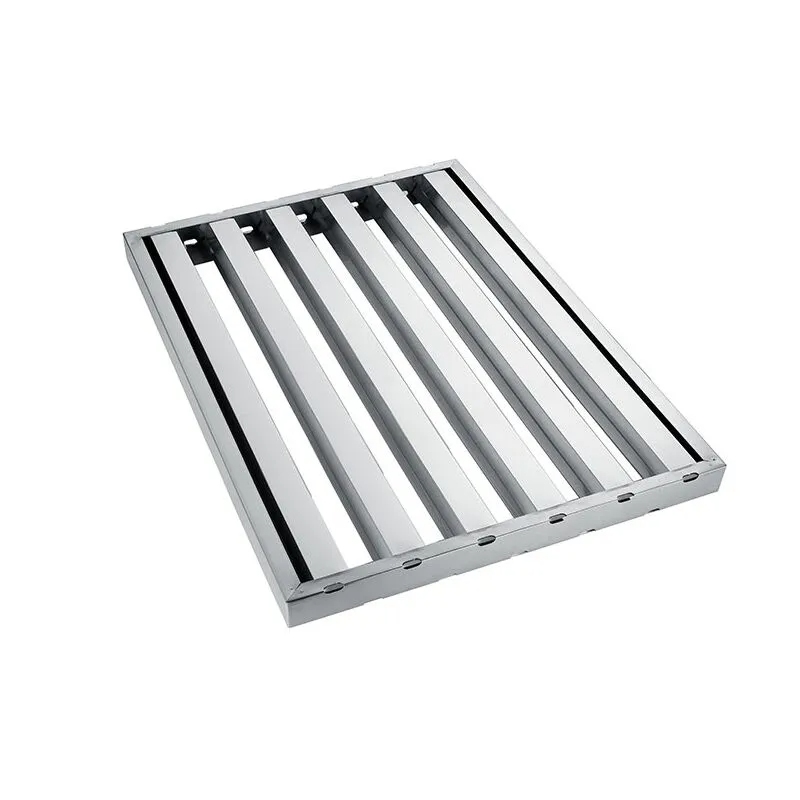
Measure the hood channel and the old panel — both
Replacement sizing starts with two measurements, and they answer different questions. The old filter tells you what somebody chose before. The hood channel tells you what a new panel actually has to fit. When those two disagree — and in older kitchens they often do — the hood channel wins, because the previous panel may have been an approximate replacement that was never quite right.
Start with a panel that is still in reasonable condition. Lay it flat and check whether the frame is still square; a dropped or warped panel will give you one honest dimension and three dishonest ones. Measure each dimension at more than one point and write down the largest figure. Then move to the hood: measure the upper and lower retaining channels inside the filter bank, from inside edge to inside edge, because most commercial panels install by lifting the top edge into an upper channel before dropping the bottom edge into its seat.
That installation movement matters as much as the final opening. A panel can be nominally small enough for the channel and still impossible to angle into place if the top clearance is wrong, which is why installers ask for the channel depth, not just the opening width.
The six figures that belong on your measurement sheet
Three numbers get all the attention, but width, height and depth alone do not describe how a filter interacts with its hood. A sheet that produces a first-time fit covers six points:
1. Installed width. Outer frame edge to outer frame edge, horizontal when the filter is in service. Measure the frame, never the internal baffles or mesh — the frame is what meets the channel.
2. Installed height. Bottom outer edge to top outer edge. This dimension controls how the panel engages with the upper and lower tracks.
3. Frame depth. Front face to rear face. Depth decides whether the panel sits flush in the retaining channel or protrudes enough to interfere with adjacent panels and hood channels.
4. Frame profile. Turn the panel sideways and record any formed lip, flange, recess or drain feature. Two filters with identical nominal dimensions can be non-interchangeable because their edge geometry engages the channel differently. Photograph the profile if drawing it is not practical.
5. Handle position. Note which face the handle is on and where it sits relative to a fixed frame edge. The handle must stay reachable once neighboring panels are fitted, and its position also tells the manufacturer which way the panel installs.
6. Airflow direction. Every baffle filter is directional: the formed channels guide grease down into catch troughs, so the panel only works correctly one way. Mark top and bottom, front and rear, on the sheet. A rectangular filter cannot always be freely rotated.
Write units on the sheet itself — mm or in, explicitly. When a buyer, a distributor and a factory work across markets, a bare number with no unit is the cheapest possible way to receive a container of beautifully made filters in the wrong size.
Why one panel's dimensions are not the whole bank
Filter banks are built from multiple panels side by side, and small errors compound across them. If every replacement is two millimeters narrower than the original, a four-panel bank accumulates an eight-millimeter gap — enough for a visible ribbon of unfiltered air to bypass the bank entirely. Measure the entire bank as well as individual openings, and count how many panels of each size you actually have. Kitchens are routinely surprised to find one odd-sized panel hidden at the end of a run.
Fit and performance travel together. Filter structure, condition and installation all influence how air moves through the bank, so dimensional compatibility is the entry ticket, not the finish line. A panel that leaves gaps forces the exhaust fan to move the same air through fewer open panels, loading the remaining filters faster and shortening their service intervals.
Check any sample against the neighbors before signing off an order. A single panel can look correct in an empty channel and still overlap or undercut when the full bank is assembled — particularly when you are replacing only part of a set.
Standard sizes, rounding and when to go custom
The industry runs on a set of common trade sizes, and most hoods built around them take standard panels. Trade size conventions vary between markets, so confirm two things with any supplier: whether the stated size is nominal or actual, and whether the actual panel runs slightly undersized for insertion clearance. Nominal numbers describe the category; actual dimensions describe the part. Orders go wrong when one side of the conversation assumes the other meaning.
If your measurements land between standard sizes, do not round down. A panel smaller than the channel opening is a bypass waiting to be inspected. The safe sequence is: match the closest standard size upward if the channel permits, otherwise go custom. Custom sizing is a normal production order for a filter manufacturer — island hoods, back-bar hoods, older European equipment and non-standard openings are all everyday requests, and cutting to a drawing costs far less than retrofitting a hood to accept the wrong panel.
When you order a batch, specify the quantity per size rather than one total, and confirm packing. Panels ship best standing on edge with corner protection. Stacked flat in a deep carton, the bottom panels carry the weight of the whole column and arrive with distorted frames — which quietly undoes every careful measurement you made.
From measurement sheet to ordered filter
A usable RFQ is short. It states the site, the hood, the quantity per size, and attaches the six-point sheet for each distinct panel. If a panel is damaged, say so — a manufacturer can often reverse-engineer the original dimensions from the channel even when the master sample is bent, but only if they know the sample is unreliable.
Serious suppliers will ask questions before quoting: which structure the hood was designed around, what the cooking line serves, whether the panels need handles on both faces. Answering these is faster than exchanging three rounds of drawings, and it is also how you find out whether the replacement should differ from what was there before. A kitchen that has converted from light to heavy frying, for example, may be better served by a different structure in the same footprint — the channel dimensions stay the same while the filter does a different job.
Keep the sheet on file once the order ships. Hoods outlive filters by a decade or more, and the next replacement — yours or a successor contractor's — should start from a record instead of another round of ladder work.
Quick answers
Should I measure the old filter or the hood opening?
Both. The old filter shows what is currently installed; the hood channel shows what a replacement must fit. When the two disagree, trust the hood channel — the old panel may be a worn or approximate replacement.
How much clearance should a grease filter have in its channel?
A few millimeters of side clearance lets a panel slide into the channel without force while staying snug enough to block unfiltered bypass. The top edge usually needs clearance to lift into the upper channel before the bottom drops into place.
What if I cannot find my filter size as a standard part?
Custom sizing is a normal order, not an exception. Send a measurement sheet — width, height, depth, frame profile, handle position and airflow direction — and a manufacturer can cut baffle, mesh or Nano panels to your drawing.
Sending us a measurement sheet?
Attach your width, height, depth, frame profile and handle position — we cut baffle, mesh and Nano panels to your sizes, standard or custom, with packing that keeps frames square.