Grease Filters by Kitchen Type: QSR, Full-Service, Ghost Kitchens and Food Trucks
A 2 p.m. Friday at a ghost kitchen behind a pizza chain. Three fryers flat out, one hood a third the size of the flagship's, and a cook who cannot pull the bank because there is no floor to stage a wash. The filter does not care what the concept is called. It cares what sits under it, how hot, how often, and whether anyone can get the panel out to clean it. Get that match wrong and you wash too often or load the duct too fast — and the second one is the finding, not the first.
Duty, not the concept: what actually loads the panel
Start with the load, not the logo. Grease is grease, but the shape of it hitting the panel changes everything — a fryer-heavy line throws a steady, heavy aerosol that buries a baffle on a tight clock, while a full-service range swings between saute, roast and griddle, lighter per hour and messier in the mix. Same grease. Four different beatings.
A baffle's whole job is one move: turn the air so grease drops before the duct. Which structure does that job is the only question that matters — how much aerosol, how fine it runs, how often you can pull the bank to wash it. Get the structure wrong and one of two things happens. You wash too often, and money bleeds. You load the duct too fast, and findings bleed. Pick by the beat, not the brochure.
Match the panel to the appliance, never the building. A baffle rated for a quiet prep line drowns over a four-basket fryer. A heavy-duty panel over a salad station is a pricier way to do nothing. The metal goes to the heat under it.
QSR: the fryer sets the wash clock
Quick-service lives and dies on the fryer. A four-basket station pushing wings and fries all day throws a dense, continuous aerosol that loads a baffle bank on a tight clock — and baffles lead here because they take the volume and walk out of the rack dishwasher unhurt. Anything finer earns a second stage behind them.
The cadence is the real story, not the concept. A QSR that washes baffles daily — sometimes between shifts in greasy seasons — is running normal, not obsessive. What is not normal is a QSR that skips the wash because the panels still look fine. That look is exactly what fails inspection — the clean-looking panel with a frame that has stopped sealing.
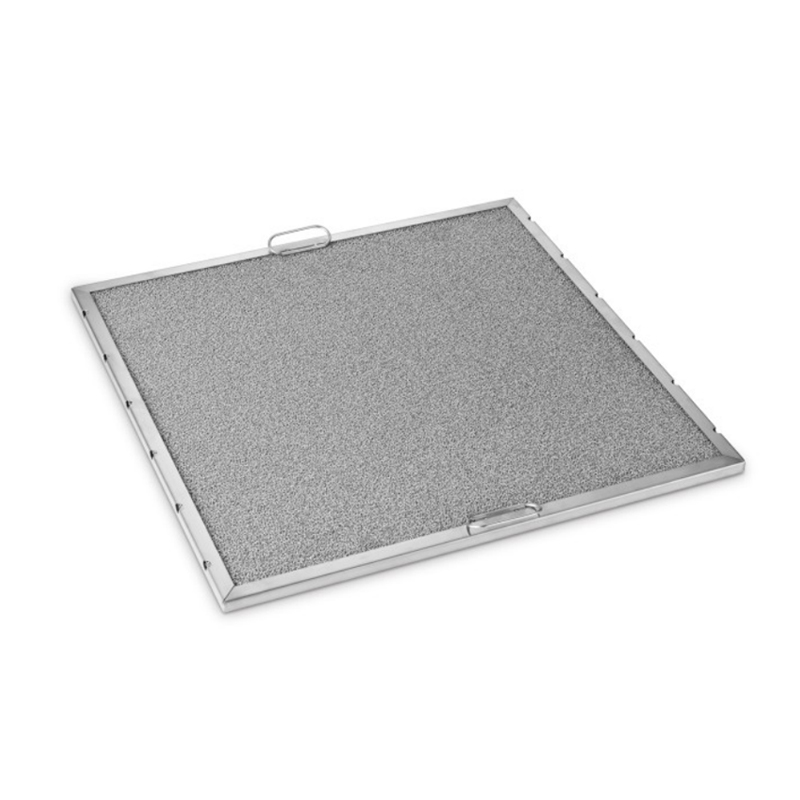
Where fine blue smoke from high-temp frying slips past capture, a BH226 Nano second stage behind the baffle pulls the remainder before it reaches the fan. On a line running twelve hours a day that is a volume play, not a luxury — the Nano earns its place by cutting duct loading, not by looking clever. The fryer owns the clock. The structure just keeps up.
Full-service: the mixed bank lies by average
Full-service mixes it up. Saute, broiler, griddle, the occasional deep fry — the load per hour is lighter than a QSR fry line, but it is dirtier in variety, and the hood often covers a wider cookline with several appliance types feeding one bank. That wide bank is where people get fooled.
Inspect by zone, not by the average. The broiler panel loads faster than the steam-table one; a panel that looks clean over pastry can be saturated over the line. The average lies, because grease does not spread itself evenly across a mixed bank. It piles where the heat is, and the only honest read is zone by zone.
Baffles still lead, and the interval stretches to weekly in most full-service houses — fine as long as capture holds. Our baffle versus mesh filter guide walks through when a mesh panel earns its place on lighter, cooler loads, though most full-service hoods stay on baffles for the wash tolerance alone. A panel you cannot dishwasher is a panel you will quietly stop washing, and then some mesh is loading grease with no clock on it at all. Keep the one you will actually pull.
Ghost kitchens: volume in a box too small to wash
Ghost kitchens are the quiet surprise. No dining room, no walk-in traffic, but a delivery-peaked fry load packed into a back room with a compact hood and a footprint you can cross in four steps. The duty is QSR-heavy; the space is food-truck-tight. That combination loads filters fast and leaves almost no room to stage a wash.
The fix is structure, not heroics. Size the baffles to the actual appliance CFM, add a Nano second stage where blue smoke is a problem, and hold a full spare set — there is no floor to stage a long wash, so the rotation is the wash. A ghost kitchen that washes in place during a peak loses orders. One with a rotation barely blinks, because the swap happens in the trough between delivery waves.
Do not assume the small room means a smaller standard. NFPA 96 applies to the ghost kitchen exactly as it does to the flagship down the street, and the inspector does not grade by square footage. The bank either seals and drains or it does not, no matter how many delivery apps you run. Size to the load and the code takes care of itself. Size to the room and you are sizing for the finding instead.
Food trucks: same code, shorter fire path
Food trucks get the most leeway in people's heads and the least in the code. The hood is compact, the appliance count is low, but a single fryer or griddle in a confined steel box throws a concentrated load straight at a small bank — and the fire path is shorter because everything sits close together.
Wash space on a truck is almost nil, so a two-panel spare rotation matters more than in any restaurant. Swap at the commissary, wash later; filters that cannot be pulled on a truck stay in too long, and that is how a small hood ends up in a fire report nobody filed.
A listed baffle that fits the footprint is the baseline. A Type U baffle listed to UL 1046 gives a compact hood a panel that meets the listing the inspector will ask about, and it still washes like a baffle should. Spec the panel to the appliance, not to the truck's charm — the cert only helps while the panel is true and sealing.
Match the structure to the load, not the building
Step back and the pattern is plain, once you stop reading the concept and start reading the load. Heavy continuous fry — baffle first, Nano behind it where blue smoke slips, wash daily. Full-service mixed — baffle first, wash weekly, inspect by zone. Ghost kitchen — baffle plus Nano and a full rotation, never a wash during a peak. Food truck — listed baffle, a two-panel spare, wash at the commissary.
The cadence follows the duty, every time. A quiet-cafe interval fails in a ghost kitchen; a ghost interval over-washes a prep line into the ground. Set the clock by what actually comes off the appliances and log it — when the menu changes or a new station fires up, the clock moves with it. The menu is the clock.
Log the structure on a single sheet by station, with the wash day written in pencil, not ink — because the day a new fryer fires up, the interval for that bank changes and the old date lies. Small footprints do not lower the bar; they raise the cost of getting it wrong, since the duct is closer and the margin is thinner. Spec to the duty, keep the spares, and the inspection stays boring. Boring is the win.
Quick answers
What grease filter works best in a ghost kitchen?
Size the baffles to the appliance CFM and add a Nano second stage where fine blue smoke escapes capture. The footprint is tight and there is no floor to stage a long wash, so hold a full spare set and run a two-bank rotation — swap during a delivery peak and you lose no orders. That is the whole point of the ghost kitchen's volume model: protect the peak, not the concept.
Do food trucks need listed grease filters?
They do. NFPA 96 applies to a food truck exactly as it does to a full-size restaurant, and the fire path is shorter because everything sits close together in a steel box. A listed baffle that fits the compact hood is the baseline — UL 1046 covers grease filters for exhaust ducts, and the inspector will ask for it. Spec the panel to the appliance, not to the truck's size, and keep a spare on board. The small box does not get a small rule.
How do QSR filter intervals differ from full-service?
A QSR fry line throws a dense, continuous aerosol, so baffles get washed daily and sometimes between shifts in greasy seasons. Full-service mixes lighter, more varied loads and washes weekly, but inspect by zone — the broiler panel loads faster than the one over the steam table. The interval tracks the duty, not the building type. Always.
Unsure which structure fits your line?
Tell us your kitchen type, appliance list and hood dimensions — we will spec the right baffle and Nano mix plus a spare rotation that matches your duty.